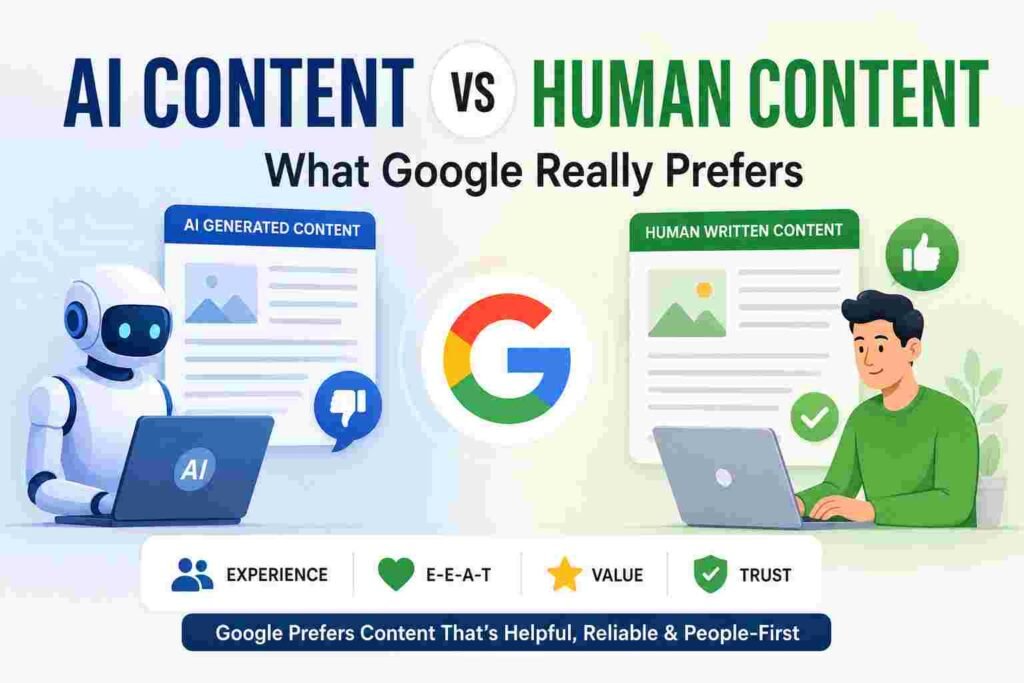
People talk about this topic like there is some secret switch inside Google. There is not. The real question is simpler, even if the answer is a little messy: can the content actually help a person, or does it just look like content? Google says its systems are built to reward helpful, reliable, people-first pages, and its guidance on AI-generated content makes it clear that AI is not the problem by itself, but scaled, low-value content can be. That is the practical lens behind Google AI Content Guidelines, Does Google Rank AI Content, and AI vs Human Writing.
And honestly, that is where most websites go wrong. They either panic and avoid AI completely, or they lean on it so hard that the page ends up sounding like a clean, empty template. Neither path is great. The better path is more grounded: use AI where it helps, keep the human brain in charge, and build pages that answer real questions in a way people can trust. That is also the sort of approach a Delhi-based SEO and digital marketing consultant like Dinesh SEO Freelancer positions himself around, with services that include SEO, PPC, SMO, ORM, content strategy, analytics, and AI SEO or AEO work.
What Google wants
Google has repeated the same basic idea in different forms for years. Create content for people, not just for ranking tricks. Its guidance says generative AI can be useful for research and structure, but using it to mass-produce pages without adding value may violate spam policies. It also says SEO best practices still matter for generative AI features in Search, which means the old fundamentals did not disappear just because AI arrived.
That matters because a lot of people still imagine Google as a machine that simply “detects AI” and punishes it. That is too crude. The quality of the page is far more likely to get Google’s attention than the tool used to build the page. Whether the page was written by a human or a model, if it is thin, repetitive, copied, vague, or only written to attract clicks, it is in trouble. The more useful, original, and clearly written a page is for a reader, the better its chances of success. That is the heart of Google AI Content Guidelines in practice.
AI is not the enemy
Let us be fair to AI for a moment. It can be genuinely helpful. It can speed up research, suggest outlines, uncover related questions, and help you get past the blank-page problem. Google itself says generative AI can be useful when researching a topic and adding structure to original content. So the issue is not the tool. The issue is what you do with it after the first draft exists.
A lot of people hear that and then assume Does Google Rank AI Content is the only question worth asking. Actually, the more useful question is this: Does the content solve a problem better than the pages already on page one? If the answer is yes, the content has a real chance. If the answer is no, then it probably will not matter whether a writer, a freelancer, or a model touched it first. Google’s own guidance on helpful content keeps circling back to usefulness, satisfaction, and intent.
This is why AI content can work beautifully for certain tasks. Product descriptions, first drafts, content outlines, FAQ skeletons, idea generation, and data organization are all places where AI can save time. But the final layer still needs judgment.
Where humans win
Now, this is where many people don’t want to hear. Nothing beats the human touch when it comes to writing that allows for taste, experience, nuance and the sense of trust. AI can imitate tone. It cannot truly know what it feels like to explain a problem to a confused customer in Jaipur, or to make a technical service page useful for a business owner in Delhi who just wants more leads, not another polished speech. That difference is small on paper and huge in practice.
In AI vs Human Writing, the strongest pages are usually not purely one or the other. They are mixed. AI may do the heavy lifting. A human adds judgment, examples, local context, and the little details that make the page feel lived in. A good writer notices when a sentence is too neat, too symmetrical, too safe. That little imperfection, that slight irregularity, often makes the page feel more believable. Perhaps that sounds minor. It is not. It is often what keeps people reading.
Think about a service business page. An AI draft might say, “We provide comprehensive digital marketing solutions for business growth.” Fine. Technically correct. Also forgettable. A human version might say, “If your site is sitting there with traffic but no enquiries, or your local business is invisible in search, the problem is usually not one thing. It is often the mix of weak content, poor structure, slow pages, and weak search intent matching.” That second version feels more useful because it sounds like someone has actually seen the problem before.
So, can it rank?
Yes, but not because it is AI. It ranks because the page earns it. That is the plain truth behind Does Google Rank AI Content.
Google does not give you a ranking as a participation award. The page needs to be useful to the searcher, but also must be competitive against other pages and must be relevant to the searcher’s intent to the extent that it is worthy of being visible.
If AI helps you produce a better page, that page can rank. If AI helps you produce ten near-identical pages with no real value, they may all sink.
Google’s newer AI-related guidance also makes an important point. Traditional SEO is still relevant, as its generative AI experiences still depend on core search ranking and quality systems. But even with clean structure, crawlability, helpful headings, internal links, answers, and trustworthy content, it remains important. In other words, AI search did not erase SEO. It made the basics more important, not less.
The human edge
The strongest version of AI vs. human writing is not a fight. It is a workflow. AI can help with speed. Human editing brings the page back to earth. That means checking facts, adding examples, removing fluff, making the tone match the brand, and making sure the page sounds like it was written for a real person with a real concern.
This is also where location-based context helps. Suppose a business serves Delhi, Noida, Gurugram, Jaipur, or Mumbai. The content should sound like it understands that audience. It should mention the kinds of problems those businesses actually face, like local visibility, lead quality, map ranking, service-area clarity, or slow conversion from search traffic. That kind of specificity makes a page feel more useful and more credible, which is exactly the direction Google keeps nudging creators toward.
How to make it work
The practical answer is not hard, although it does require discipline.
Start with a real search intent. Write down what the user is actually trying to learn, compare, fix, or buy. Then use AI for the rough draft, not the final judgment. Add examples from real situations. Remove anything that sounds like filler. Check the headings. Check the first paragraph. Check the ending. If the page can survive that process, it is probably in good shape.
This is also where Google AI Content Guidelines matter in a very simple way. Do not publish content just because it exists. Publish it because it is useful. Do not build pages at scale that say the same thing in different words. Do not pretend automation is insight. Google has been consistent about rewarding helpful content, and its AI guidance keeps returning to that idea from a newer angle.
Common mistakes
A few mistakes show up again and again.
One is writing in a voice that sounds polished but hollow. Another is repeating the same point in slightly different clothes for no reason. Another is stuffing in keywords like a checklist. Google is not looking for that. Readers are not looking for that either. They want pages that feel like someone knew what they were talking about.
The other mistake is assuming Does Google Rank AI Content is a yes-or-no question with no conditions. It is conditional. It depends on usefulness, originality, search intent, structure, and trust. A great human page can fail. A smart AI-assisted page can win. The deciding factor is usually quality, not who touched the keyboard first.
FAQ
1. Can AI-written content rank on Google?
Yes, it can. Google says content should be judged by its usefulness and quality, not simply by whether AI was involved. But content created at scale without real value may run into spam policy issues. That is why Google AI Content Guidelines matter so much in practice.
2. Is human writing always better than AI writing?
Not always. Of course, human writing is typically more powerful in experience, judgment, nuance and trust. AI is quite helpful for rapidity, organization, and concept development. It’s not a competition between AI vs human writing; it’s more about how to use them together for the best results.
3. Does Google punish AI content?
Google says it does not punish content just because AI was used. The bigger issue is low-value or scaled content that does not help users. So the real risk is poor quality, not the tool itself. That is another reason Does Google Rank AI Content depends on execution, not labels.
4. How can businesses use AI content safely?
Use AI for drafts, outlines, research support, and repetitive tasks. Then have a human edit the content, add experience, check facts, and make it match the audience. For businesses that want a stronger SEO and digital marketing setup, a consultant like Dinesh SEO Freelancer, who focuses on SEO, AI SEO, local search, and content strategy, fits that kind of work well.
Conclusion
The truth is, Google doesn’t care about human content or AI content. The reality is that Google is not really a fan of AI content over human content. It’s not that simple. Google wants content that can help people, answer the query, and make them feel they can trust it and keep it for. If AI is going to get you there, so be it. If it makes the page a bit fuzzy and repetitive, that is bad for you. Simple, that is.When people ask about Does Google Rank AI Content, AI vs Human Writing, and Google AI Content Guidelines, the answer is: Use AI as a helper, not a replacement. Human eye on Meaning, Usefulness and Truth. After all, that is how pages maintain meaning for search, and that is how a serious SEO partner such as Dinesh SEO Freelancer can help a business build something which continues to make good sense when the search world changes yet again. Perhaps this is the point for everyone to take home. Not who wrote it. How it affects the reader.